Stewardship Starts Within · Part 5 of 9
Stewarding Your Communication Gifts
Learning to communicate well requires wisdom, restraint, honesty, timing, humility, and grace.
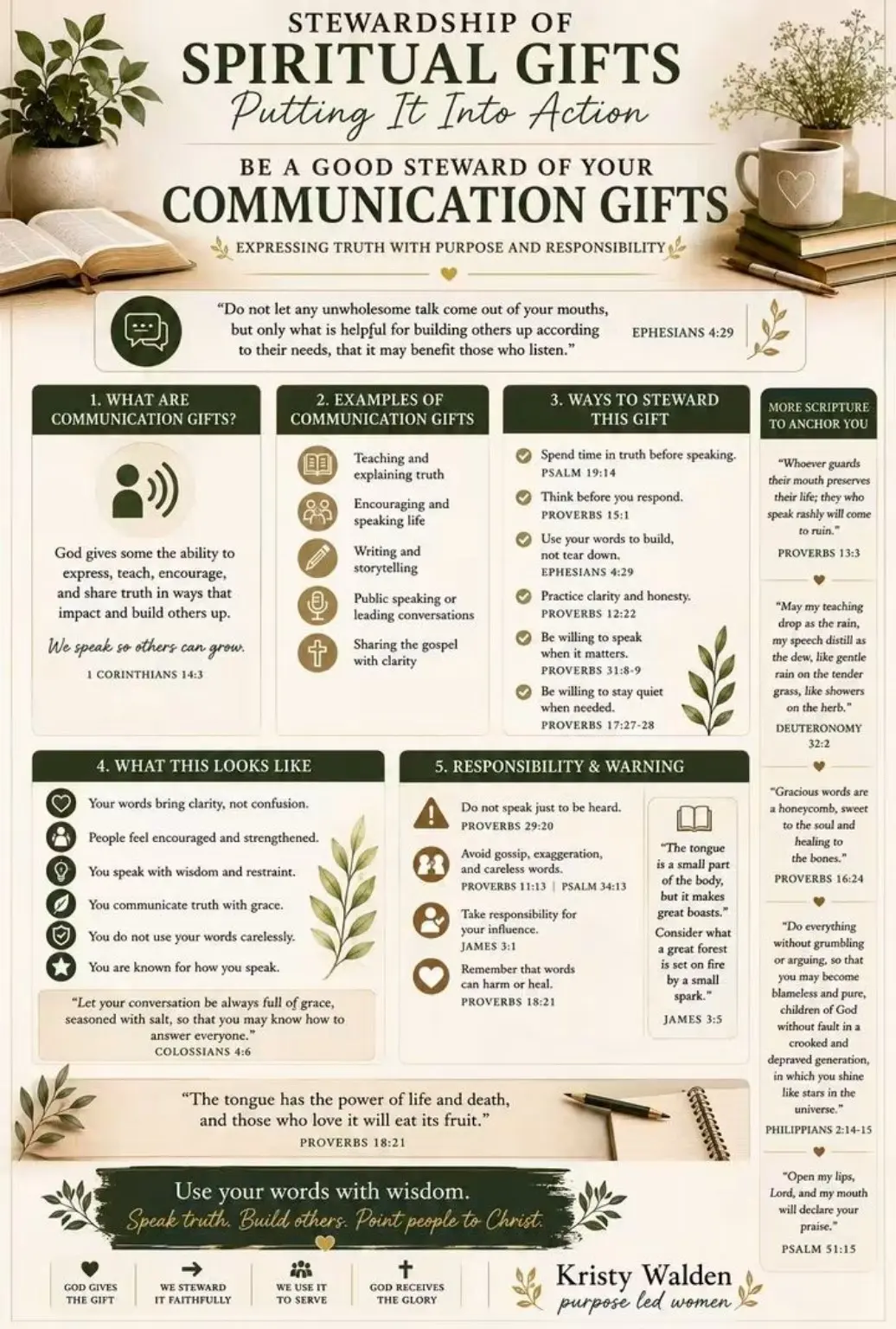
“Let no corrupt communication proceed out of your mouth, but that which is good to the use of edifying, that it may minister grace unto the hearers.”
Ephesians 4:29 (KJV)
“Wherefore, my beloved brethren, let every man be swift to hear, slow to speak, slow to wrath:”
James 1:19 (KJV)
“A soft answer turneth away wrath: but grievous words stir up anger.”
Proverbs 15:1 (KJV)
“Let your speech be alway with grace, seasoned with salt, that ye may know how ye ought to answer every man.”
Colossians 4:6 (KJV)
“Death and life are in the power of the tongue: and they that love it shall eat the fruit thereof.”
Proverbs 18:21 (KJV)
Communication affects every part of our lives: our homes, relationships, leadership, friendships, and even the way people experience Christ through us.
Learning to communicate well is not just about saying more. It is about learning wisdom, restraint, honesty, timing, humility, and grace.
Sometimes the most mature thing we can do is speak up. Sometimes it means remaining quiet, listening longer, or responding differently than our emotions want us to.
Words can heal, encourage, teach, clarify, and build people up. They can also wound deeply if we are careless with them. That is why stewardship matters so much here.
I am still learning this myself and still growing in it, but I know our words matter more than we sometimes realize.
Words entrusted to us
Communication is stewardship because words carry influence. They can clarify truth, create safety, bring courage, and repair what has been strained. They can also confuse, expose, manipulate, or wound. Maturity asks us to consider not only whether something is true, but whether our timing, tone, and purpose reflect Christ.
Listening is part of faithful communication. Being quick to hear gives us space to understand before assuming, to recognize what our emotions are doing, and to invite the Holy Spirit into our response. Restraint is not avoidance; sometimes it is the wisdom to wait until our words can build rather than tear down.
Grace-filled speech does not abandon honesty. It tells the truth without using truth as a weapon. It apologizes clearly, asks questions humbly, refuses gossip, and accepts responsibility for the influence of its words. The goal is not simply to sound kind, but to communicate in a way that helps people encounter the character of Christ.
Do my words usually bring clarity and grace or pressure and confusion?
Where do I need to listen longer before responding?
Is there a truth I need to speak with greater humility, wisdom, and love?
Use your words with wisdom. Speak truth. Build others. Point people to Christ.